
PAST ISSUES
For years, the National Organic Program has made strides in addressing the challenges of program implementation. A 2010 review of the organic program by the Office of Inspector General (OIG) found that certifying agents were not conducting regular and consistent, periodic residue testing, and in some cases were not conducting required onsite assessments of certified operations. The USDA OIG assessment report included recommended remedies, and issues were addressed. A subsequent 2017 report concluded that overseas organic equivalency standards were not sufficiently transparent, and that NOP import documentation was not consistently verified at ports of entry. Furthermore, some certified organic products being imported may have been fumigated with treatments that were not compliant with organic standards. This fumigation may have been necessary from a Customs and Border Protection perspective, but would have rendered these products as no longer compliant with NOP organic standards. The need for fumigation occurs less frequently with camellia sinensis product, but may be necessary with certain botanical ingredients used in tea blends and herbal tea blends. As such, these past issues impacted the US organic tea industry to varying degrees.
The potential for fraud has been another significant and ongoing concern. Not only do fraudulent organic products de-value the perception of the organic brand, but high enough volumes can affect the pricing of organic products. When fraudulent organic products can be produced and sold at cheaper prices than authentic organic products, this raises the risk that legitimate organic producers get pushed out of business.
IMPACTS OF STRENGTHENING ORGANIC ENFORCEMENT (SOE)
Some of the major changes included in the SOE regulations that will impact the tea industry include:
Exemptions. Under the old regulations more entities along the supply chain could be considered exempt, especially if they were handling the finished, packaged product and not coming in contact with the actual raw materials (leaf in the case of tea). Under the new regulations, organizations that sell in bulk from the farms, load/unload, store/warehouse, transport, and repackage organic products WILL LIKELY need to be organic certified. To be clear, not all warehouses holding organic tea will necessarily need to be certified organic. Not all ocean container ships transporting organic tea will need to be certified. The best way to understand what exemptions are allowed under the new SOE regulations is to contact your organic certifying agent for clarification.
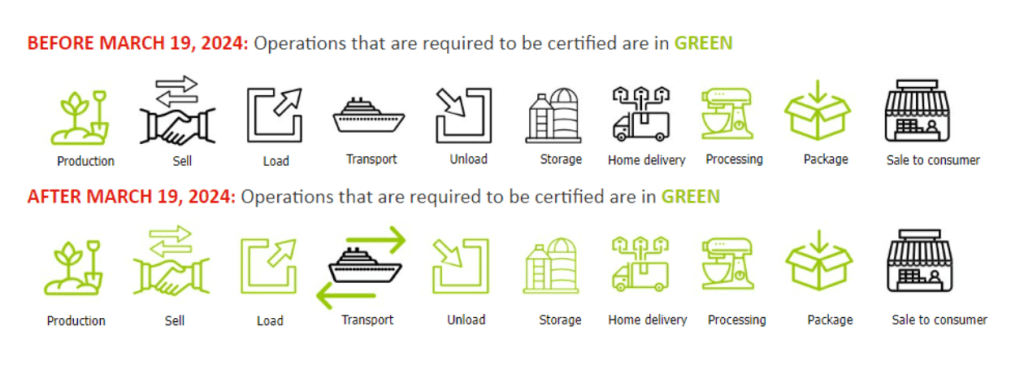
Traceability, Fraud Prevention, and Inspections. Operations must include a fraud prevention plan as part of their organic system plan. During annual inspections, inspectors will conduct “in-out” and “trace-back” audits. These aim to verify that correct volumes of organic materials are accounted for coming in and out of the operator’s facilities. Inspections must also verify the organic products and organic ingredients are compliant back to the previously certified operation in the supply chain. In addition, certifying agents/organizations must also identify “high risk” operations and products. High-risk products may come under greater scrutiny as they are traced throughout the supply chain.
NOP Import Certificates (NOPIC). The NOPIC may be one of the newer and more significant changes affecting how certifier organizations in the country export get involved in the documentation of organic tea from origin. Imported organic products must be declared to the US Customs and Border Protection’s Automated Commercial Environment (ACE) system using data from an NOPIC that is to be generated by the exporter’s certifying agent/organization.
Since the majority of the world’s US organic tea is exported from a few major countries, the new NOPIC requirement could affect the timeliness and costs related to the import/export process. A representative of Ecocert USA was contacted to explore how the NOPIC may impact the flow of tea imports into the US.
Q: Will a rise in demand for organic exports following the Spring tea harvest and the associated requests in NOPICs create delays or the need for more processing times for exports?
A: “Starting March 2024, exports to the USA shall be accompanied by a NOP Import Certificate (NOPIC). Before issuing an NOPIC, the certification agency will define specific verifications to confirm the compliance of the goods. Concerning Ecocert, the level of verifications may depend on the risk of the supply chain in question. The riskier the supply chain, the more robust the verifications before issuing the NOPIC. This administrative step, to obtain the NOPIC, which was not required beforehand, will need to be anticipated by the exporter to avoid any delays.”
As such, it would seem that the infrastructure and systems for processing NOPIC requests is considered robust and sufficient, but delays could be related to certifiers’ (of exporters) level of familiarity with the submission process and the varying degrees of compliance documentation that is required. Only the certifiers of exporters, not the certified organic tea exporting organization itself, will be uploading documentation and requesting the NOPIC. Any organization or product that has been deemed high-risk by the certifying organizations MAY require the certifier of export to submit more extensive documentation with the NOPIC request.
Q: At what point in the process does the NOPIC need to be received by the exporter and/or importer? Before leaving the country of origin? On landing in the US? Other?
A: “There is no rule defined in the SOE about the reception date.The only date is about the NOPIC requesting date. Per 205.273(a) of the SOE regulations: ‘Persons exporting organic agricultural products to the United States must request an NOP Import Certificate from a certifying agent prior to their export.’ It is also mentioned that each import must ‘be associated with valid NOP Import Certificate data’ while being declared as organic to US Customs and Border Protection (on the ACE portal).”
NOTE: the rule was recently updated to clarify: “the NOPIC should be issued “before departure”
Q: As I understand, certifying agents determine their own fees in terms of processing/verifying NOP import certificates. Is there a consensus across certifying agents in various countries as to standardizing the fees/rates?
A: “At the time of writing, there is no consensus on the fees related to the issuance of NOP Import Certificates (NOPIC) among certifying agents. Each certifying agent will communicate the fees to their clients once they are defined.”
IMPACT
As the SOE regulations go into effect, operations in the certified organic supply chain have been made aware of the changes needed to comply with the new rules. Overall, the new rules seek to improve compliance and security of the organic supply chain while imposing as little added administrative burden as possible. Operations involved in USDA organic certified tea can expect the need to process more documentation and (perhaps) an increase in surprise inspections. It is worth noting that the SOE regulations are designed to increase traceability, but not necessarily transparency. In most cases, certified organic operations are required to document traceability back to the most recent certified upstream operation. Neither operators nor consumers can necessarily expect to have access to records that visibly trace a product through all the actors in the supply chain back to origin.
The tea industry will not be the only agricultural product affected by the rollout of these new regulations, but considering the U.S. imports nearly all of its organic c. sinensis and a significant amount of organic botanicals used in teas and herbal tea blends, the effects may be more widespread. Each year, about 2 percent of c. sinensis import volumes are organic, but that share rises to 8 or 9 percent of the total value of tea imports. Since these imports arrive from various countries with the potential for multiple certifying agents active in those countries, some countries and tea suppliers may vary in terms of adapting to these changes. US organic tea operations that are concerned about these changes are advised to reach out to their certifying agent organization and the certified organizations in their supply chain to better understand any potential impacts to their businesses.

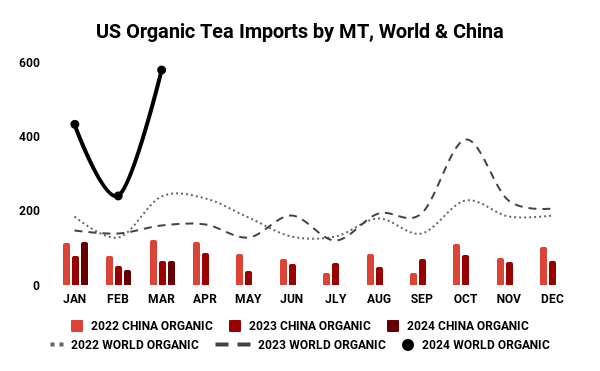
Following up on these developments since the regulations went into effect has shown a marked uptick in organic imports in the first quarter of 2024. There are a couple of possible explanations for the significant rise in reported organic tea imports. Imports in Jan- to early March may have been organic imports being brought in before the new rules came into effect in order to avoid the need to for extra administrative and documentation efforts related to securing a NOPIC. Another explanation may be that exporters/importers have shifted their practices to more accurately report organic product under the appropriate imports codes. Previously imported organic teas may have been declared as conventional teas because is wasn’t necessary to specify them as organic imports in order to sell them as organic after arrival. As a result of these changes, however, total monthly organic tea imports are now ranging between 74-260% HIGHER than the corresponding 2023 month. This also means that organic teas as a share of total teas imported each month is rising from around 2.5% up to about 5%.
OTHER RESOURCES
https://usdaoig.oversight.gov/sites/default/files/reports/2023-12/01801-0001-21finaldistribution.pdf
https://ota.com/advocacy/critical-issues/strengthening-organic-enforcement