
2024 saw continued growth for the global tea industry, in terms of overall production and exports from tea-producing countries. Along that same pattern, China saw expansion in tea acreage, production, and exports. This growth further secured China as producer of over half of the world’s tea, the top green tea producer, and the nation’s western provinces as the largest tea-producing segment within the country. Tariffs and trade relations with the U.S. may affect a thin slice of China’s global tea trade, but increasing domestic consumption and the strength of larger, more critical export markets can easily dwarf these trade war concerns.
EXPORTS
Global tea exports from producing countries rose by about 11.9 percent over the previous year to reach 1.9 million MT, with China exports increasing by 1.8 percent. China also maintained its place as the producing country with the second highest volume of exports. Kenya took the top position, having increased their exports by 13.7 percent over 2023 levels for a total of 595,000 MT. Kenya accounted for 30.6 percent of global exports from producing countries. China’s 0.37 mmt of exports accounted for 19.2 percent of global exports from producing countries, and represented a 10 percent share of China’s total annual production.

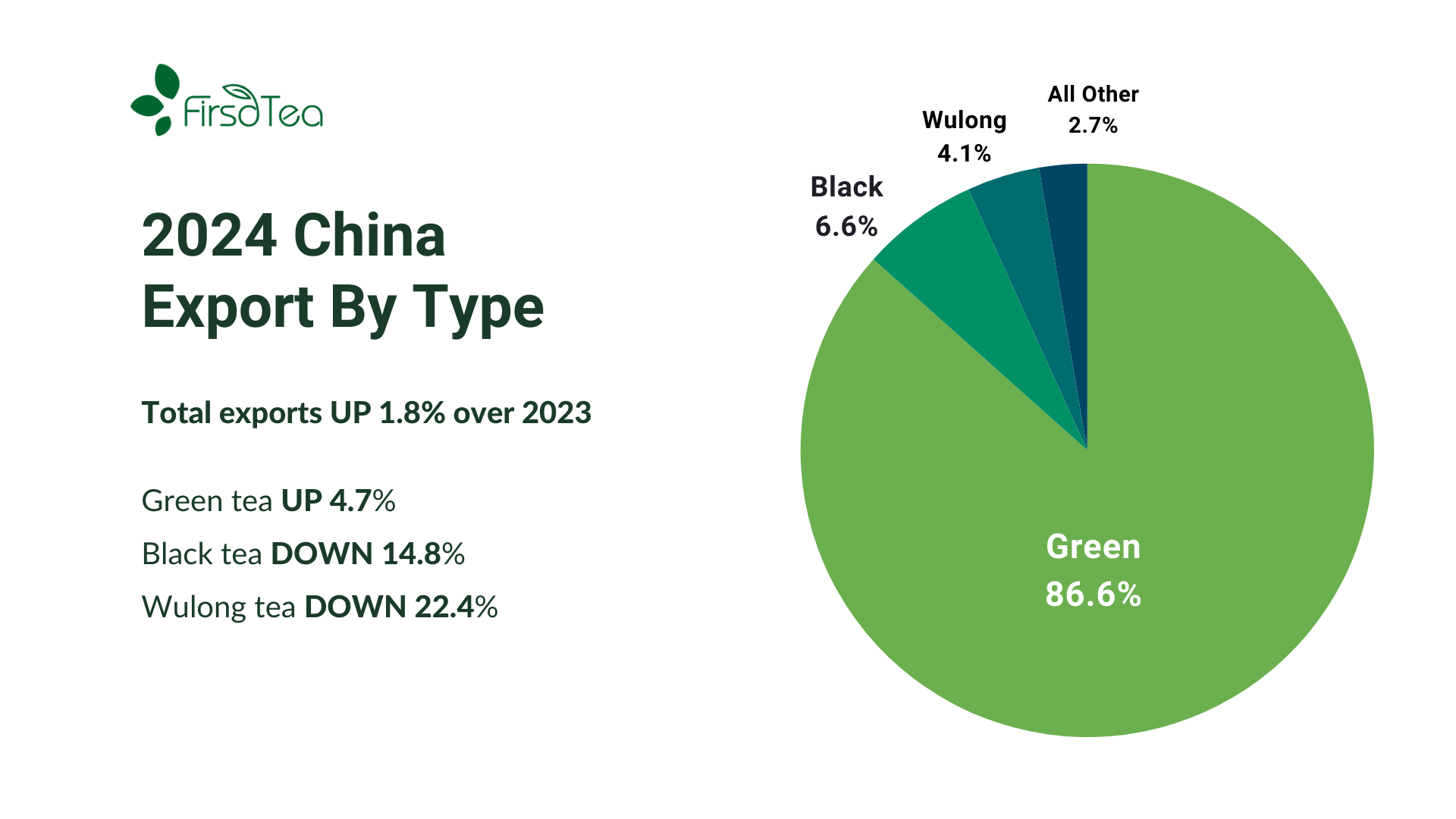
86.6 percent of China’s tea export volume was green tea and the next highest volume was black tea with 6.6 percent. Green tea exports rose by 4.7 percent over the previous year, but black tea continued a 2-year decline. Black tea exports were 14.8 percent lower than the previous year. This rise and fall in black export volumes coincided with a few factors, but China’s black tea exports have generally followed an inverse trend in relation to the overall rise in export volumes out of India and Sri Lanka.
Exports to Morocco, China’s largest tea export partner, showed signs of recovery. Most years, Morocco alone takes in about 20% of China’s exports, usually around 75,000 metric tons. 2023 saw levels decline by about 16 percent from 75,400 metric tons to 59,800 metric tons, but 2024 saw exports rebound to 80,584 MT. Ghana and Uzbekistan took the 2nd and 3rd positions, taking in 10.3 and 6.7 percent of imports,respectively. Taken together, these three countries imported 38.5% of China’s tea exports. Russia, usually ranked as the 7th largest importer of Chinese teas, narrowed out Algeria, Senegal, and Mauritania to take 4th place- a gain of 13.7 percent in export volume. 2023 saw exports to the US at a 5-year low, but the predicted re-balance of inventories resulted in a 37.5 percent increase in exports from China, and making the U.S. the 8th largest export destination.

OUTLOOK
Looking forward, the 2024 data points toward a positive trajectory for China tea in 2025. China’s overall production capacity continues to expand. Domestic consumption will continue to be shaped by the rise of innovative and improving tea beverage offerings- including higher quality bubble tea drinks, and bottled teas incorporating a wider range and quality of base teas. Export markets, while shifting slightly in their total volumes, appear stable overall. Tariffs will loom heavily for the US market. From China’s perspective, 0.3% of China’s annual tea production volume is exported to the U.S. Seen from the U.S. side though, China tea imports account for about 10 percent of both volume and value. The U.S. consumer stands to lose more than the Chinese seller if tariffs on tea are not stabilized at a sustainable level.