
2024 saw continued growth for the global tea industry, in terms of overall production and exports from tea-producing countries. Along that same pattern, China saw expansion in tea acreage, production, and exports. This growth further secured China as producer of over half of the world’s tea, the top green tea producer, and the nation’s western provinces as the largest tea-producing segment within the country. Tariffs and trade relations with the U.S. may affect a thin slice of China’s global tea trade, but increasing domestic consumption and the strength of larger, more critical export markets can easily dwarf these trade war concerns.
PRODUCTION
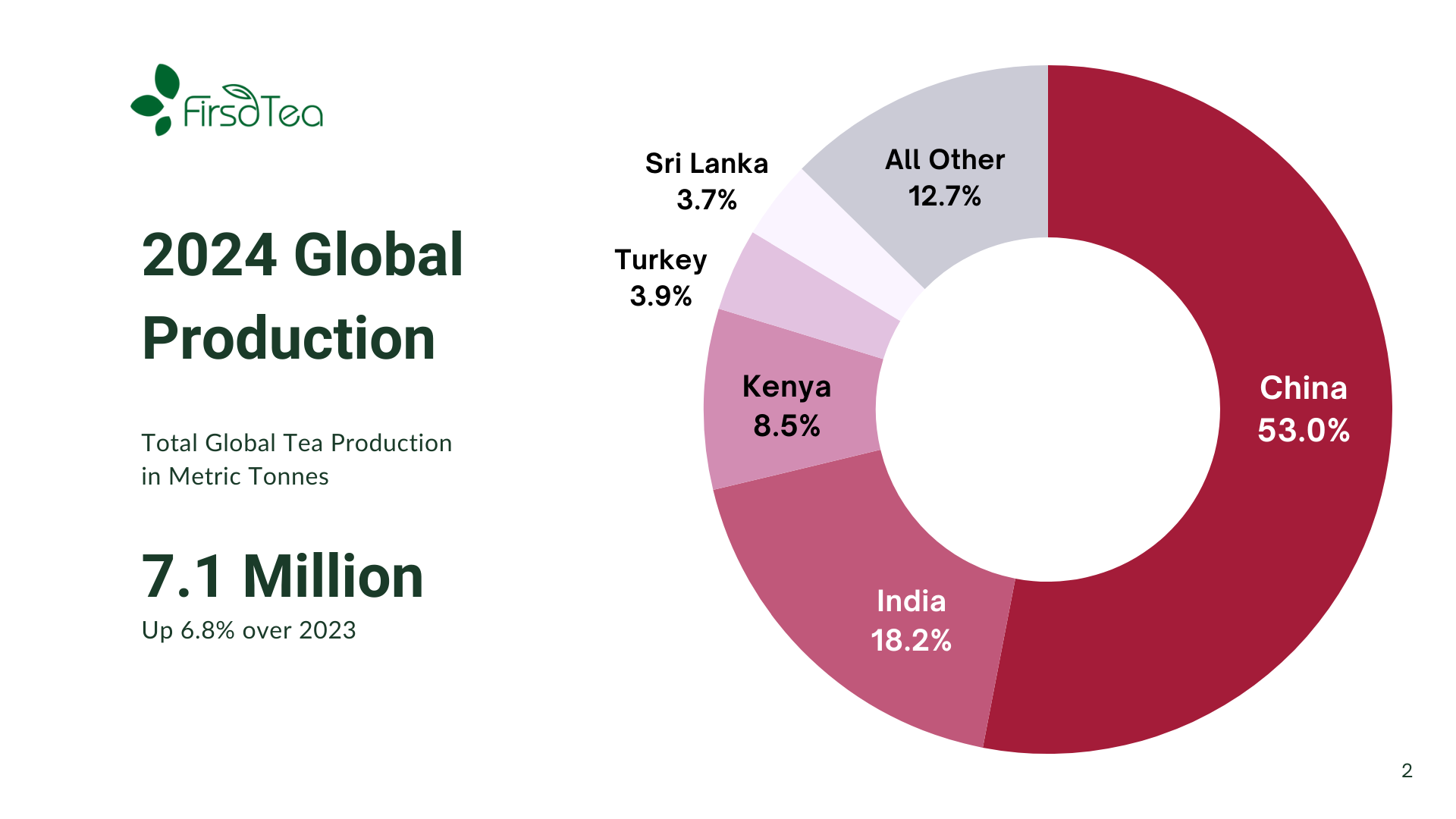
Global tea production rose by 6.8 percent over the previous year, from 6.6 to 7.1 million metric tons (mmt). China accounted for 53 percent, or 3.7 mmt, of global production volume while increasing their own production by 12 percent over the previous year. India took second place with 18.2 percent even with a production drop of 6.1 percent. The industry watched intently, as the Assam region particularly saw a shortened season and reduced yields. Kenya rounds out the top 3 producers with 8.5 percent of the world’s annual production. Taken together, these 3 producers account for 80 percent of global production for 2024. Other major tea-producing countries saw shifts in production levels. Turkey edged out Sri Lanka to become the fourth largest producer by volume. Bangladesh saw a 9.6 percent drop in production, which coincided with civil unrest and the overthrow of the Bangladeshi government. Argentina, a significant source of black teas for the US market, saw a recovery, increasing its production levels by 19.1 percent over the previous year. Overall global tea production levels are expected to continue rising.
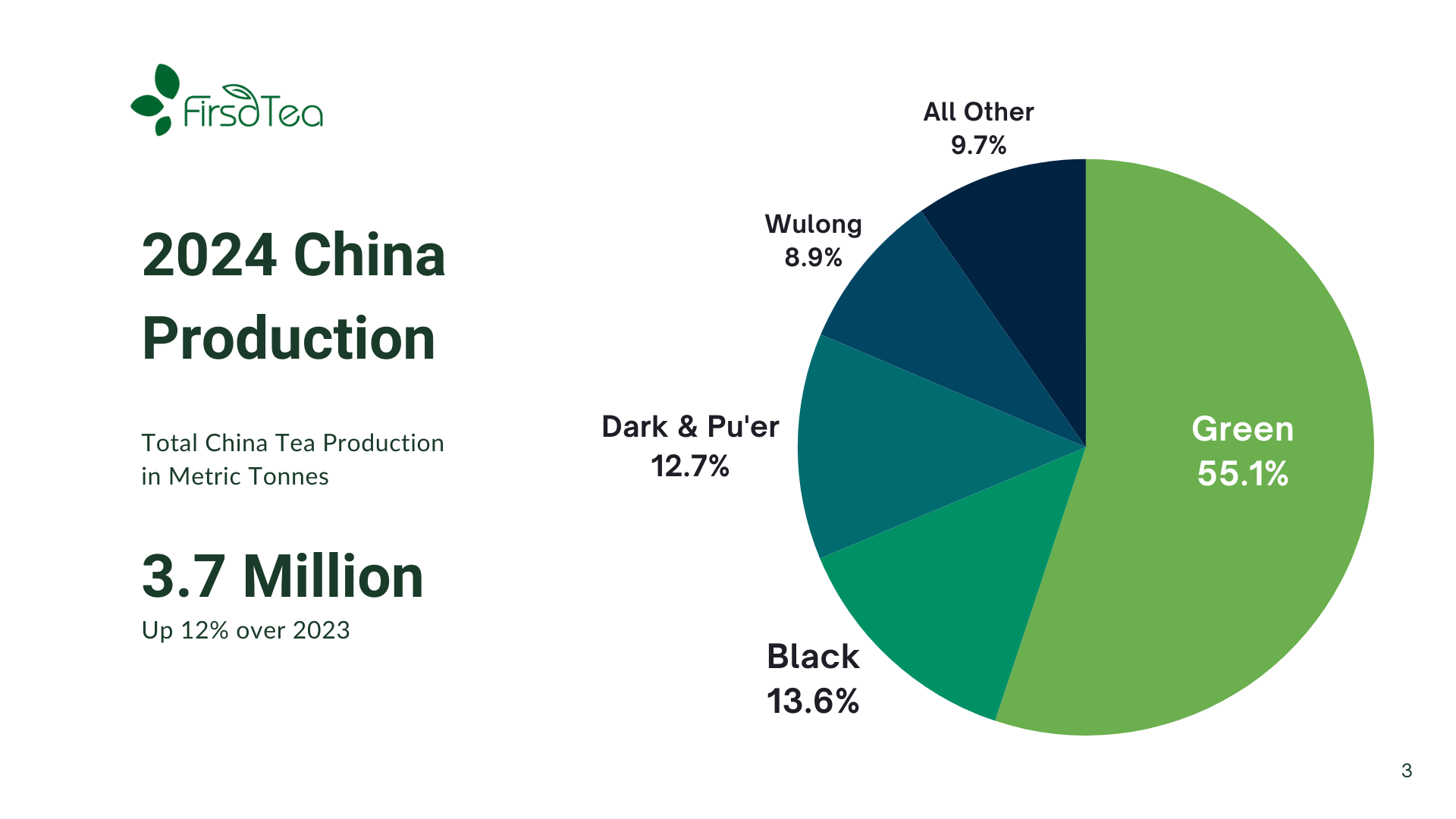
Unlike the other main tea growing countries, China is primarily a green tea producer. 55.1 percent, or 2.1 mmt of China’s 2024 production was green tea, followed by 0.51 mmt of black tea. This green tea alone accounts for 29.1 percent of 2024 global tea production. The remainder of China’s tea is dark (hei) 12.7 percent, wulong 8.9 percent, white 2.5 percent, and yellow tea at 0.8 percent. In 2019, black tea surpassed dark tea as the second-largest segment of tea production. Since then, production volumes of the two have remained fairly close. The broader popularity of black tea, along with growing domestic demand for RTD teas and black tea’s relatively high average export price speaks in favor of further gains in black tea production share. Black tea has also become increasingly important to China’s domestic market, especially with the rapid growth and popularity of bubble teas and other beverages that are part of what has been termed the “new-style tea beverage” industry.
At time of publication, official data on production levels at the provincial level were incomplete, and only estimates were available. Based on these estimates, China’s top four tea producing provinces (Fujian, Yunnan, Sichuan, and Guizhou) accounted for half of China’s tea production, and they each showed increases in production of between 2 and 7 percent. Preliminary data also showed double-digit gains in production by Anhui and Shaanxi provinces, but these numbers are pending confirmation. Yunnan narrowly beat out Fujian to become the largest tea-producing province, further enhancing the Western Belt’s (Yunnan, Sichuan, and Guizhou provinces) position as the dominant tea producing segment. These Western provinces contribute a combined total of over one-third of all Chinese tea, 19 percent of total global tea. The Eastern Belt (Fujian, Anhui, and Zhejiang) and Central Belt (Hubei, Hunan, and Shaanxi provinces) each produce about 25 percent of China tea each year.
As with production data at the provincial level, numbers for acreage per province are incomplete at time of writing. Total hectare (HA) totals for China reached 3.5 million HA, up 1.8 percent over 2023, and continuing a steady upward trend over the past 5 years and beyond. Over the past few years, the Western Belt (Yunnan, Guizhou, and Sichuan provinces) has held about 40 percent of China’s tea fields, and the Eastern (Zhejiang, Fujian, and Anhui provinces) and Central (Hubei, Hunan, Shaanxi provinces) Belts containing 20 percent each. 5-year growth trends (2019-2023) also show the Western Belt increasing its yield per HA by double-digit percentages, compared to smaller gains of 6-10 percent in yield per HA for the other belts. The Chinese government has encouraged the establishment of tea fields in the more poverty-impacted counties of the Central and Western Belts as a means of promoting rural development and strengthening local incomes. Efforts appear to have made progress, as the central government declared victory in eradicating poverty and now aims to secure more infrastructure development and economic stability in those areas. So, not only are the Western Belt provinces literally gaining more tea ground, they are coaxing more leaves out of their tea fields.
OUTLOOK
Looking forward, the 2024 data points toward a positive trajectory for China tea in 2025. China’s overall production capacity continues to expand. Domestic consumption will continue to be shaped by the rise of innovative and improving tea beverage offerings- including higher quality bubble tea drinks, and bottled teas incorporating a wider range and quality of base teas. Export markets, while shifting slightly in their total volumes, appear stable overall. Tariffs will loom heavily for the US market. From China’s perspective, 0.3% of China’s annual tea production volume is exported to the U.S. Seen from the U.S. side though, China tea imports account for about 10 percent of both volume and value. The U.S. consumer stands to lose more than the Chinese seller if tariffs on tea are not stabilized at a sustainable level.
[…] Twitter LinkedIn This is a follow-up to the 2025 China Tea Report: Production article that includes further data on province- and belt-level changes in […]
Comments are closed.