
Amidst a year of increasing global tea production and decreasing exports from producing countries, China continued to lead the pack in production while also taking second in exports. It also remains the dominant source of green teas along with the widest variety of types of tea, including wulong (oolong), white, yellow, and dark teas. Domestic China consumption of teas remains strong, so the forecast for the Middle Kingdom’s tea continues to look bright.
PRODUCTION
Global tea production rose by 3.2 percent over the previous year, from 6.4 to 6.6 million metric tons (mmt). China produced just over one half of the world’s tea in 2023. The Middle Kingdom accounted for 50.6 percent, or 3.3 mmt while increasing their production by 5 percent over the previous year. India took second place with 20.7 percent of global production, having increased their yield by 2 percent. Kenya rounds out the top 3 producers with 8.6 percent of the world’s annual production. Taken together, these 3 producers account for 80 percent of global production for 2023. The top four tea producing countries saw gains in production, including Sri Lanka. Ceylon tea production increased by 1.8 percent after having experienced a tumultuous period of economic struggle and agricultural policies that stymied tea production levels. Argentina, a significant source of black teas for the US market, has seen steady production declines for several years. Argentine tea production decreased by 4.5 percent over 2022 levels. Given historic trends and that the major producers continue to increase their production, overall global tea production levels are expected to continue rising.

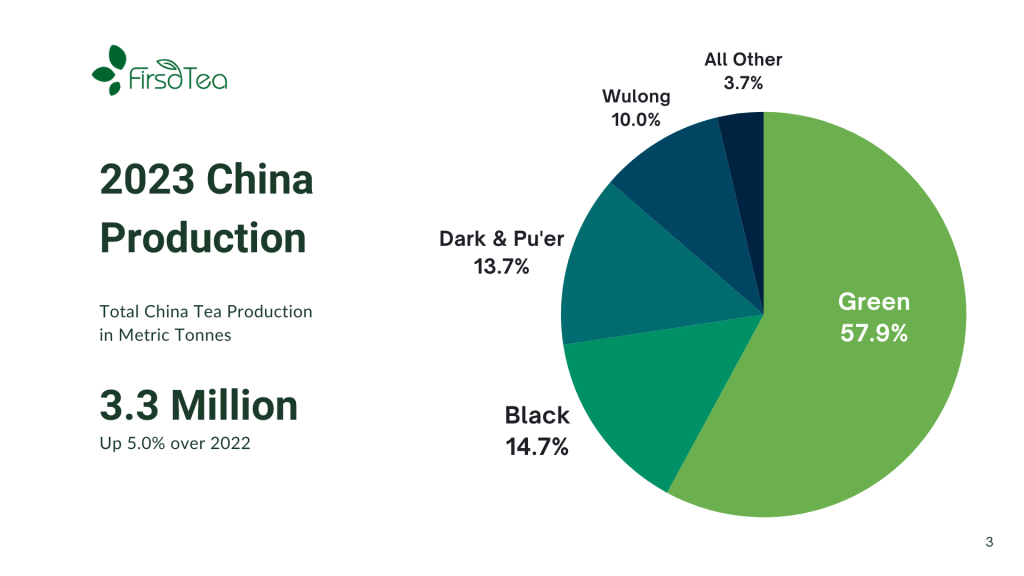
Unlike the other main tea growing countries, China is primarily a green tea producer. 57.9 percent, or 1.9 mmt of China’s 2023 production was green tea, followed by 0.49 mmt of black tea. This green tea alone accounts for just under 30 percent of 2023 global tea volume. The remainder of China’s tea is dark (hei) 13.7 percent, wulong 10 percent, white 3 percent, and yellow tea at 0.7 percent. In 2019, black tea surpassed dark tea as the second-largest segment of tea production. Since then, production volumes of the two have remained fairly close. The broader popularity of black tea, along with growing domestic demand for RTD teas and black tea’s relatively high average export price speaks in favor of further gains in black tea production share.
GROWING REGIONS
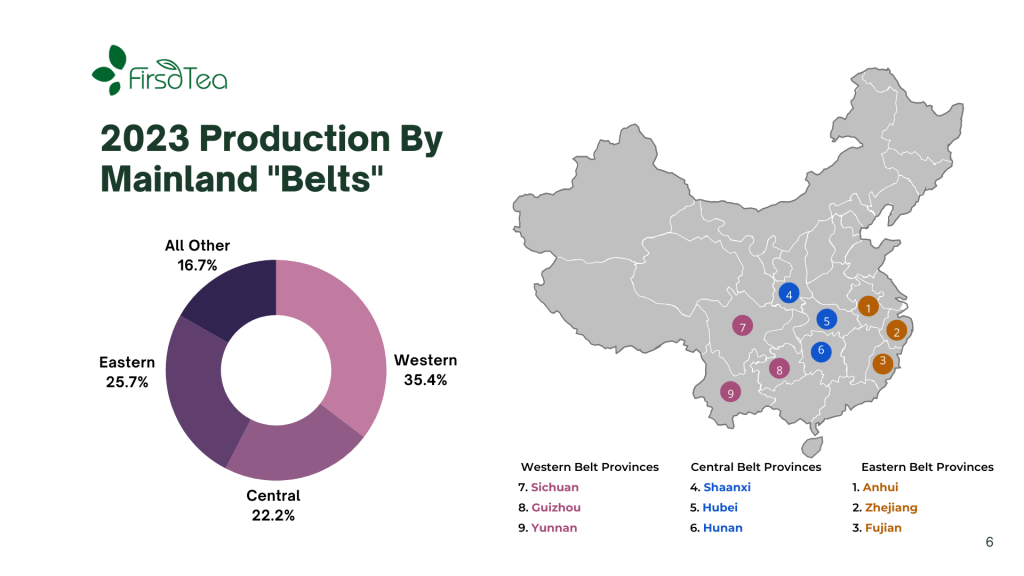
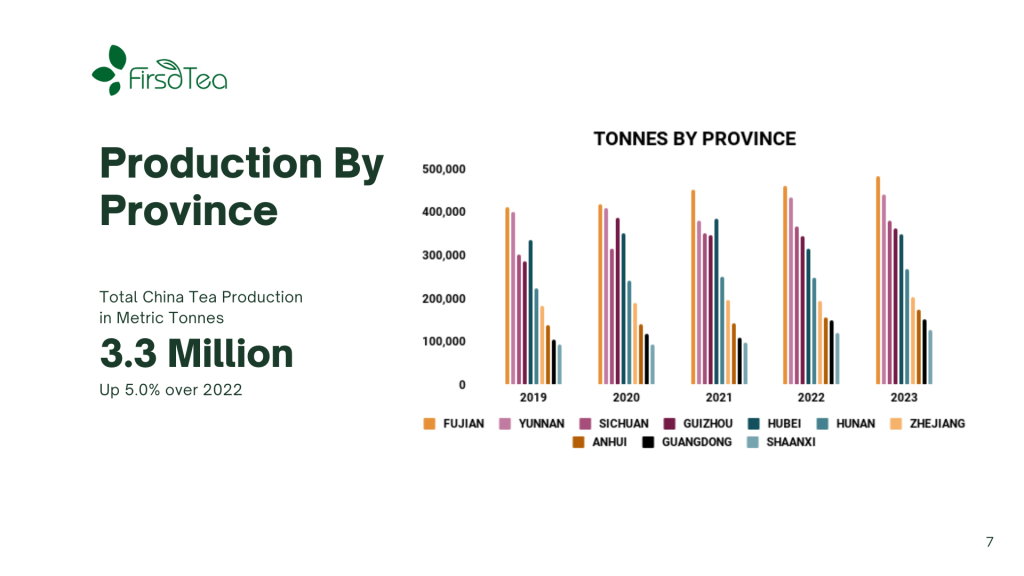
China’s top four tea producing provinces (Fujian, Yunnan, Sichuan, and Guizhou) accounted for half of China’s tea production, and they each showed increases in production of between 1 and 5 percent. Double-digit gains in production were exhibited by Hubei, the 5th largest producer with a 10.6 percent gain, and Anhui, the 8th largest producer with a 12.4 percent gain. While Fujian may be the single largest tea-producing province, the greatest share of tea is still grown in the Western Belt (35.3 percent from Yunnan, Sichuan, and Guizhou provinces combined) followed by the Eastern Belt (25.7 percent from Fujian, Anhui, and Zhejiang). The Central Belt (Hubei, Hunan, and Shaanxi provinces) follows close behind with 22.2 percent of production.
YIELDS
Fujian may also be China’s top yielding tea province in terms of tons per hectare, but it is only fifth in terms of growing area. Yunnan province leads the pack with over 0.51 million hectares (mha) of tea fields, followed by Guizhou (0.47 mha), Sichuan (0.40 mha) and Hubei (0.38 mha). Fujian’s advantages lie in its warmer climate and more established production areas. The Chinese government has encouraged the establishment of tea fields in the more poverty-impacted counties of the Central and Western Belts as a means of promoting rural development and strengthening local incomes. Efforts appear to have made progress, as the central government declared victory in eradicating poverty and now aims towards securing more infrastructure development and economic stability. For tea production, however, training these less-experienced workers continues. Outputs are expected to improve along with the maturity of young tea plants and the advancement of tea workers in the areas. A notable exception is Guangdong province, which has the second highest yield per ha. The province does produce some well-known teas, like yingde black tea and dan cong wulong, but the province is generally better known for its industrial output and commercial trade. Guangdong ranks ninth in overall tea production and thirteenth in hectares planted. It shows little sign of dedicating more land to future tea production.
OUTLOOK
China’s overall tea trends appear positive. Production levels are on track to increase around 4.5-5 percent based on average annual increases. Spring 2024 weather in most areas has cooperated, providing a healthy crop thus far. Development in tea producing areas, especially the Western and Central Belts, remains steady. Domestic consumer demand also appears to be on the uptick. The China tea industry has been highlighting the need for promoting demand, and recent years have seen the introduction of increased bottle teas and other tea-based RTD beverage sales. China is poised to maintain its dominant role in global tea.